In a bizarre and controversial glitch, Google briefly allowed prediction market platform Polymarket to appear alongside legitimate news sources in Google News—blurring the line between journalism and gambling. The incident sparked immediate backlash, raising serious questions about how algorithms decide what qualifies as “news” in an era increasingly shaped by data, speculation, and real-time betting.
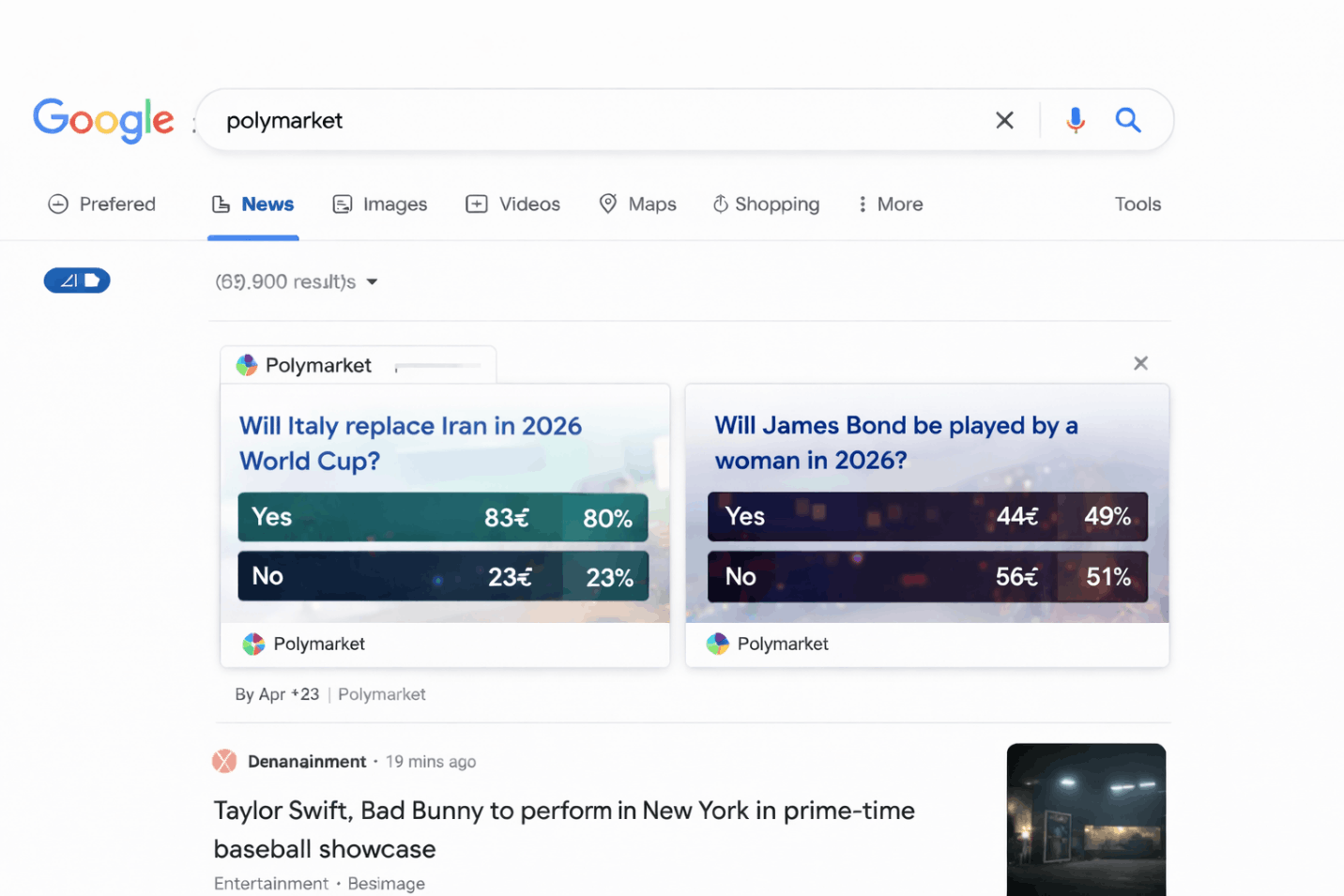
The issue came to light when users noticed Polymarket listings appearing directly within Google News feeds. Instead of traditional headlines, these entries featured betting-style questions—ranging from tech trends to geopolitical events—presented in a format that resembled actual news coverage.
In some cases, these prediction markets even appeared at the top of personalized “For You” sections, outranking established outlets. Searches for real-world events would also return Polymarket bets alongside trusted publications such as Reuters or the Financial Times, creating a confusing mix of reporting and speculation.
The result? Users were exposed to what looked like authoritative news, but was actually based on crowdsourced betting sentiment.
Following criticism, Google quickly responded, clarifying that the inclusion of Polymarket was not intentional. The company stated that Google News is designed to prioritize original reporting from credible sources, and that the platform had appeared there “in error.”
Soon after, Polymarket links disappeared entirely from “News” results.
While the fix was swift, the situation revealed a deeper vulnerability: even one of the world’s most powerful information platforms can struggle to distinguish between content and speculation when automated systems are involved.
Polymarket isn’t a traditional media outlet—it’s a prediction market where users wager on the likelihood of real-world events. Topics range from elections and financial markets to conflicts and viral internet moments.
Supporters argue that such platforms act as a “truth signal,” aggregating public sentiment in real time. Critics, however, see something more troubling: a system that monetizes uncertainty and, in some cases, incentivizes misinformation or manipulation.
The controversy intensifies when these markets intersect with real-world events—especially sensitive ones like wars or political decisions—turning serious developments into betting opportunities.
This incident didn’t happen in isolation. Google has already explored integrating prediction market data into its financial tools, suggesting a broader interest in alternative data sources.
That raises an important question: Could prediction markets eventually become part of how people consume information?
If so, the distinction between reporting facts and predicting outcomes may become increasingly blurred. Platforms like Polymarket thrive on probabilities, not verified truths—yet their format can easily resemble authoritative reporting when placed in the wrong context.
At its core, this controversy highlights a growing identity crisis in digital media.
Algorithms now decide what billions of people see, but those systems don’t always understand nuance. When betting markets can appear alongside journalism, it challenges the very definition of news itself.
Is it news about what has HAPPENED, or what people THINK WILL HAPPEN?
Google’s quick rollback suggests the company still draws a firm line. But the fact that the line was crossed at all shows how fragile that boundary has become.
While Polymarket has been removed from Google News, the broader conversation is far from over. As prediction markets grow in popularity—and investment—pressure will mount on tech platforms to define their role more clearly.
For now, Google has reaffirmed its commitment to traditional news standards. But in a world driven by algorithms, the next “error” may not be so easy to spot.