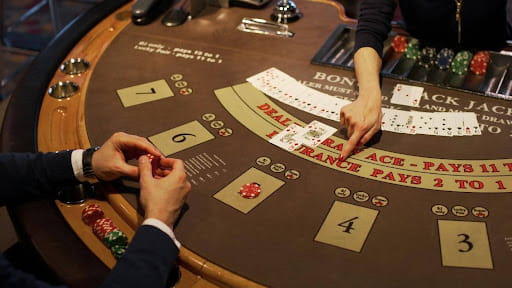
At first, nothing changes on your end. Same table, same chips, same dealer rotation.
But behind the scenes, someone is watching more closely.
In land-based casinos, that might mean surveillance zooming in a bit tighter, or a floor manager lingering near your table just a little longer than necessary. Online, it’s less visible but arguably more precise—your account gets flagged for review, and your gameplay data starts getting pulled into internal risk models.
They’re not trying to “catch” you doing something illegal. Most of the time, they’re trying to answer a simpler question:
“Are you just running hot, or are you playing smart?”
That distinction matters more than people think.
This is where things get slightly… inconvenient.
If you’re playing table games, you might notice subtle rule changes depending on where you play next. Maybe the blackjack table you liked suddenly switches to a version with worse payout rules. Maybe the deck penetration gets shallower. Maybe that friendly dealer who let things flow quickly will be replaced by someone who moves more slowly and is more rigid.
Online, the changes are different but still noticeable. You might see fewer favorable tables, or certain game variations quietly disappear from your usual rotation.
None of this is random. Casinos tweak conditions all the time—but if you’re winning more than expected, you’re more likely to feel those tweaks directly.
This is one of the more obvious moves, though casinos rarely present it as such.
If you’re winning at a level that raises eyebrows, betting limits can start to work against you. In physical casinos, this might mean being encouraged to play at tables with lower maximum bets—or finding that higher-stakes tables are suddenly “reserved” or unavailable.
Online, it’s cleaner. Your account might get adjusted so that maximum bet sizes are reduced. Or certain high-value wagers simply become inaccessible.
Interestingly, minimum bets rarely go up in your favor. It’s almost always about capping your upside.
And from the casino’s perspective, that’s just risk management.
Casinos love rewarding players—until they don’t.
If you’ve been receiving regular bonuses, cashback offers, or VIP perks, you might notice those offers becoming less frequent… or less generous. The system that once flagged you as a “high-value customer” starts reclassifying you as something else entirely.
Not a problem. Just… less profitable.
Some players assume this is a mistake or a glitch. It usually isn’t. Promotional budgets are carefully allocated, and casinos are unlikely to keep incentivizing someone who’s consistently taking money out rather than putting it in.
Occasionally, you’ll still get offers—but they’ll be structured in ways that are harder to exploit or less favorable overall.
At some point, especially online, you might be asked to verify your identity again.
And again.
To be clear, KYC (Know Your Customer) procedures are standard across the industry. But for winning players, these checks can become more frequent or more detailed. Requests for documents, proof of address, and payment method confirmations—it can start to feel like a loop.
Most of it is legitimate compliance. But it also serves another purpose: slowing things down.
Withdrawals might take longer. Reviews might take days instead of hours. It’s rarely framed as a restriction, but the friction is real.
And for some players, that alone is enough to discourage continued play.
In physical casinos, this is where things can get a bit more personal.
A manager might approach you. The tone is usually cordial. They might compliment your play, ask how long you’ve been visiting, maybe even offer you a drink or a meal.
But occasionally, the conversation takes a different turn.
You might be asked to limit your bets. Or told that certain games are no longer available to you. In rare cases, especially in advantage-play situations, you could be asked to leave—or not return.
Online, this step is less theatrical but just as final. You might receive an email outlining changes to your account status. Or a notice that certain features have been restricted.
It’s not dramatic. But it’s definitive.
This is the endpoint, though not every winning player reaches it.
If a casino determines that your play is consistently unprofitable for them—and not just due to short-term variance—they may decide to cut ties.
Online, that could mean account limitations, withdrawal-only status, or full closure. In land-based casinos, it might mean being politely (or not so politely) told that your action is no longer welcome.
It’s worth noting: this doesn’t necessarily mean you did anything wrong.
Casinos operate on margins. If you disrupt those margins enough, they reserve the right to protect their business. It’s not personal, even if it feels that way.
Still, for players who take pride in beating the system—even temporarily—it’s a strange kind of badge of honor.
| Pros | Cons |
| Walking away with consistent profits is the obvious upside — very few players ever reach this level | Increased scrutiny from the casino, both online (data tracking) and offline (surveillance, floor staff attention) |
| Strong game understanding (strategy, discipline, bankroll control) translates into real financial advantage | Game conditions can quietly worsen — lower payouts, fewer favorable tables, or limited access to certain games |
| Builds confidence and reinforces a more analytical approach to gambling rather than emotional play | Betting limits may be reduced, capping your ability to scale winnings over time |
| Potential access to VIP treatment early on (hosts, perks, personalized offers) | Promotions and bonuses often dry up once the casino identifies you as unprofitable |
| Ability to spot value opportunities that most casual players miss | Frequent KYC checks and slower withdrawals can create friction and frustration |
| Winning sessions can create flexibility — you’re playing with profit rather than chasing losses | Risk of account restrictions or even closure in online casinos |
| Sense of “beating the system,” which for many players is part of the appeal | Long-term sustainability is difficult — casinos will eventually adapt to protect their edge |
There’s a common myth that casinos hate winners. That’s not quite accurate.
They expect winners. They rely on them, even. Big wins create stories, and stories bring in more players. What casinos don’t love are consistent winners—players who don’t rely on luck alone.
That’s a different category entirely.
And it’s a small one.
Probably not much.
Most players will never trigger these responses. Not because they’re doing anything wrong, but because the math of casino games is designed to smooth things out over time.
You might win big one night. Lose the next three. End up roughly where the house expects you to.
But every so often, someone slips outside that pattern. Maybe they’ve studied the game. Maybe they’re disciplined in ways most players aren’t. Maybe they just hit a rare streak and ride it longer than expected.
When that happens, the system doesn’t break—but it does react.
Quietly. Gradually. Almost invisibly, if you’re not paying attention.
And if you are paying attention… well, you’ll probably notice before anyone says a word.
That’s usually how it goes.
KEY TAKEAWAYS: